Hydraulics Mastery – From Fundamentals to Advanced Hydraulic Systems | P L Majhi
H
HYDRAULICS MASTERY
P L Majhi
GET THIS EBOOK — ₹299
Practical Industry-Focused Reference

MASTER
HYDRAULICS.

From Fundamentals to Advanced Hydraulic Systems

Understand hydraulic components. Read circuits. Perform calculations. Troubleshoot problems. Prepare for interviews — in one practical, industry-focused guide.

Instant digital access after successful payment

PL
P L Majhi
Hydraulic Engineer | Hydraulic Maintenance Professional | Author
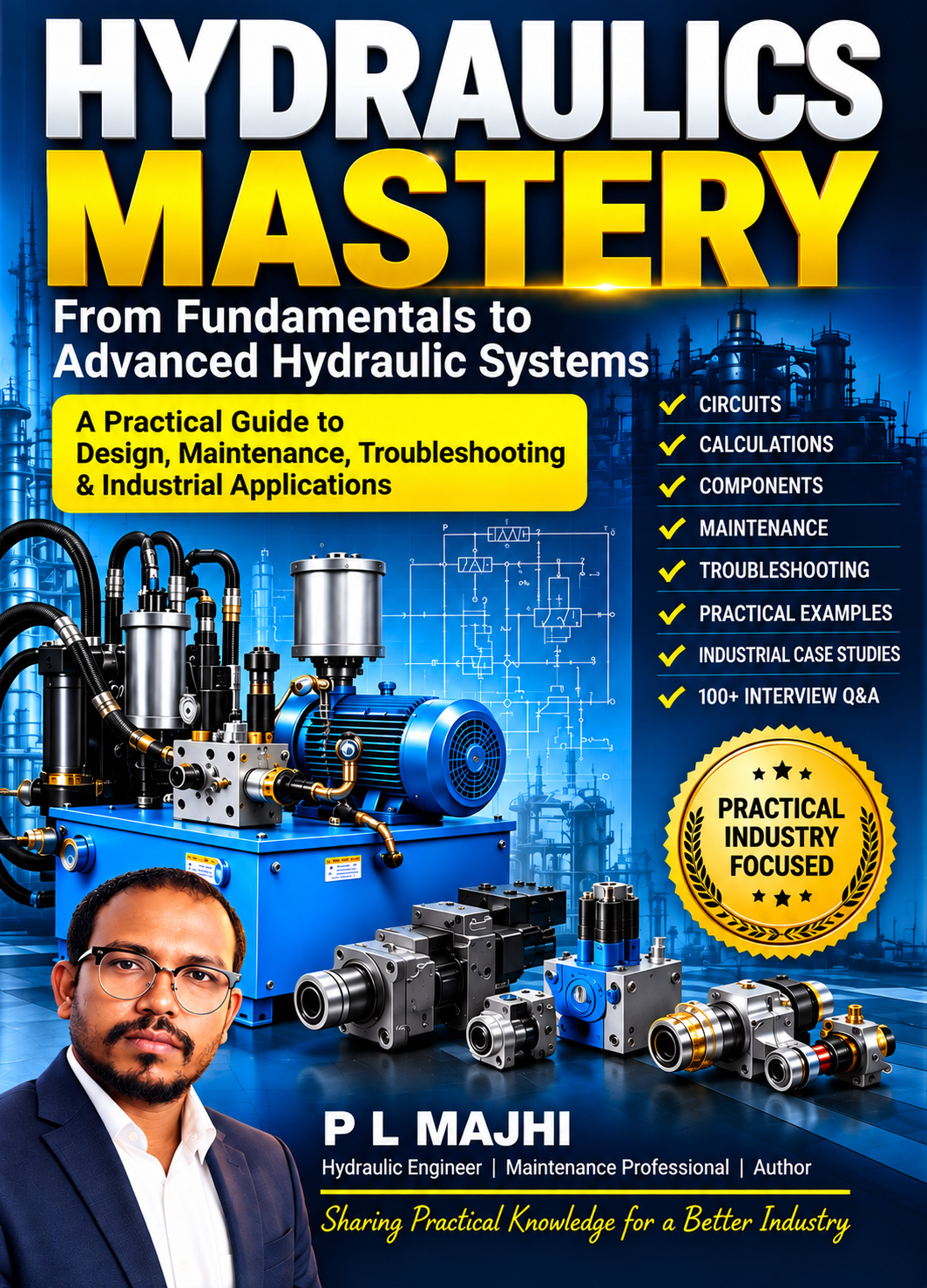
Front cover of Hydraulics Mastery by P L Majhi
Practical & Industry-Focused 22 Hydraulic Circuits Calculations & Worked Examples Troubleshooting & Maintenance Interview Preparation
25
Parts
68
Chapters
22
Circuit Types
555+
Practice Questions
31
Symptom Cards
237
Pages
01 — The Problem

HYDRAULICS IS EASY TO MEMORISE — BUT HARD TO MASTER.

Most candidates walk into a hydraulics interview having memorised isolated facts, without being able to connect concept → component → circuit → failure → fix. That chain is exactly how experienced interviewers probe candidates — and exactly how a machine actually fails on the shop floor.

01

Components learned in isolation

You know what a relief valve is, but not how it behaves inside a live circuit.

02

Circuit diagrams don't read clearly

Symbols and line paths stay abstract until someone walks you through the flow.

03

Pressure and flow get confused

The classic trap: flow sets actuator speed, pressure sets force — and a pump makes flow, not pressure.

04

Calculations feel unfamiliar

Flow, torque, power and sizing formulas are simple — once you have worked them by hand.

05

Symptoms don't lead to root causes

A noisy pump has five likely causes. Without a checking method you replace parts and guess.

06

Information is scattered

Notes, manuals, videos and forum threads — nothing that revises cleanly the night before.

02 — The Method

EVERY CHAPTER FOLLOWS THE SAME CHAIN OF THINKING.

The book moves from the underlying principle, to the real component, to how it behaves in a circuit, to what goes wrong in the field, and finally to the exact way that knowledge gets tested at interview.

STEP 01
CONCEPT

Pascal's Law, pressure, flow, power, efficiency.

STEP 02
COMPONENT

Pumps, motors, valves, cylinders, filters, accumulators, seals.

STEP 03
CIRCUIT

22 circuit types, from meter-out to load-sensing.

STEP 04
FAILURE

31 symptom cards: causes, checking method, root cause.

STEP 05
FIX

Corrective action plus the preventive action behind it.

STEP 06
INTERVIEW

Every chapter closes with likely questions and model answers.

The book is designed to help you connect theory with components, circuits, troubleshooting and interview preparation. Outcomes depend on your own study and experience.

03 — Audience

WHO IS HYDRAULICS MASTERY FOR?

HME

Hydraulic Maintenance Engineers

Symptom → cause → checking method → corrective and preventive action, laid out as field-ready cards.

HE

Hydraulic Engineers

A single consolidated reference from fundamentals through power pack design and servo control.

ME

Mechanical Engineers

Written for engineers moving into a hydraulics-heavy role who need the fluid-power side quickly.

SE

Service Engineers

Diagnostic logic for pumps, motors, valves, oil, leakage, noise and vibration problems.

DE

Design Engineers

Sizing calculations, selection checklists, HPU design and line-velocity limits in one place.

MP

Maintenance Professionals

Preventive and predictive maintenance practice, oil cleanliness and condition monitoring.

TEC

Technicians

Tables, formula boxes and worked examples instead of long theoretical paragraphs.

STU

Diploma / ITI Students

Starts from first principles — what hydraulics is, and why it is used — before going deeper.

FRE

Freshers

A 50-question basic bank written specifically as a warm-up for a first hydraulic interview.

EXP

Experienced Professionals

Advanced sections on proportional, servo, mobile and critical industrial hydraulic systems.

INT

Interview Candidates

Six dedicated parts: question bank, top 100, real scenarios, calculations, traps and final revision.

04 — Contents

EVERYTHING YOU NEED TO BUILD STRONG HYDRAULIC KNOWLEDGE

PART 1

HYDRAULIC FUNDAMENTALS

Pascal's Law, pressure, force, area, flow, velocity, power, efficiency, pressure drop and heat.

PART 2

HYDRAULIC PUMPS

Gear, vane and piston pumps, displacement, flow calculation, cavitation and aeration.

PART 3

HYDRAULIC MOTORS

Motor types, torque, speed, case-drain behaviour and practical application.

PART 4

HYDRAULIC VALVES

Directional, pressure and flow control — including open- vs closed-centre behaviour.

PART 5

FILTERS, ACCUMULATORS & SEALS

Filtration positions, beta ratio, accumulator types, seals, reservoirs and ancillaries.

PART 6

CYLINDERS & CALCULATIONS

Cap-side vs rod-side area, extend and retract force, speed, cushioning and buckling.

PART 7

HYDRAULIC CIRCUITS

22 circuit types: meter-in/out, bleed-off, regenerative, sequence, counterbalance, load-sensing.

PART 8

POWER PACK (HPU) DESIGN

Reservoir sizing, pump and motor selection, cooler sizing and manifold layout.

PART 9

MASTER FORMULA SECTION

Every formula in the book in one place — formula, meaning, units and worked example.

PART 10

PIPES, TUBES, HOSES & FITTINGS

Line sizing to velocity limits, pressure ratings and BSP, NPT, JIC, ORFS, SAE and metric threads.

PART 11

HYDRAULIC OIL & FILTRATION

Viscosity and ISO VG grades, contamination control and ISO 4406 cleanliness coding.

PART 12

ACCUMULATORS — DEEP DIVE

Gas states, pre-charge, usable volume and adiabatic vs isothermal sizing.

PART 13

ELECTRO-HYDRAULICS

Solenoid valves, sensors, switches and electrical control of hydraulic functions.

PART 14

PROPORTIONAL & SERVO

Closed-loop position and force control, loop gain and servo valve contamination.

PART 15 & 17

MOBILE & INDUSTRIAL SYSTEMS

Excavators and mobile circuits; presses, rolling mills, reclaimers, crushers and brake systems.

PART 16

TROUBLESHOOTING

31 symptom cards across pressure, pump, actuator, valve, oil, noise and flow problems.

PART 18

PREVENTIVE & PREDICTIVE MAINTENANCE

PM schedules, oil analysis trending and condition-monitoring practice.

PART 19

HYDRAULIC SAFETY

Stored energy, pressure release, lockout practice and the injection-injury hazard.

PART 20–24

INTERVIEW PREPARATION

555+ questions, Top 100 must-know, 10 real scenarios, 15 calculation problems, 10 classic traps.

PART 25

FINAL REVISION & CHEAT SHEETS

One-page formula sheet, selection checklists, symbol reference, glossary and a 1-day revision plan.
25 parts. 68 chapters. One practical reference.
Instant digital access after successful payment
GET THIS EBOOK — ₹299
05 — Structure

THE 25-PART ROADMAP

Read start to finish, or jump straight to the part most relevant to your interview. Four stages take you from first principles to a one-day revision plan.

STAGE 1 · PARTS 1–9
BUILD THE FOUNDATION

Core fundamentals, every major component, circuits, power pack design and the master formula section.

1 · Fundamentals 2 · Pumps 3 · Motors 4 · Valves 5 · Filters, Accumulators & Seals 6 · Cylinders & Calculations 7 · Circuits (22 types) 8 · Power Pack Design 9 · Master Formula Section
STAGE 2 · PARTS 10–15
PRACTICAL & ADVANCED SYSTEMS

Piping and fittings, oil and filtration, accumulator sizing, and electronic control of hydraulics.

10 · Pipes, Tubes, Hoses & Fittings 11 · Oil & Filtration (Advanced) 12 · Accumulators (Deep Dive) 13 · Electro-Hydraulics 14 · Proportional & Servo 15 · Mobile & Industrial Hydraulics
STAGE 3 · PARTS 16–19
TROUBLESHOOTING, MAINTENANCE & SAFETY

Diagnostic logic, the critical industrial systems interviewers ask about, and safety practice.

16 · Hydraulic Troubleshooting 17 · Critical Industrial Systems 18 · Preventive & Predictive Maintenance 19 · Hydraulic Safety
STAGE 4 · PARTS 20–25
INTERVIEW PREPARATION

Turns the technical foundation into interview readiness, and closes with cheat sheets.

20 · Question Bank (555+) 21 · Top 100 Must-Know 22 · Real Interview Scenarios 23 · Calculation Problems 24 · Interview Traps 25 · Final Revision & Cheat Sheets
06 — How it teaches

BUILT FOR PRACTICAL UNDERSTANDING — NOT JUST THEORY

Tables, formula boxes and worked examples are used deliberately in place of long paragraphs. Five recurring box types run through every chapter.

FORMULA BOX

The formula, the meaning of every term, its units, and a worked example alongside it.

EXAMPLE BOX

A short worked numerical example with the arithmetic shown line by line.

INTERVIEW QUESTIONS BOX

Likely interview questions with concise model answers, at the end of each chapter.

SAFETY / WARNING BOX

A critical safety point — stored energy, injection injury, lockout — never to be skipped.

QUICK REVISION

A one-line chapter summary for last-minute revision before an interview.

Comparison tables
Circuit explanations
Symptom cards
Industrial applications
Selection checklists
Symbol reference
Definitions glossary
Rapid-fire questions
07 — Calculations

HYDRAULIC CALCULATIONS MADE PRACTICAL

Part 9 consolidates every formula in the book into one reference — formula, meaning, units and shortcut. Part 23 then puts 15 of them to work as interview calculation problems.

PRESSURE
P = F / A

The master relationship behind everything in hydraulics.

P: Pa or bar · F: N · A: m²
Shortcut: P(bar) = F(N) / [A(cm²)×100]
FLOW & VELOCITY
Q = A × v

Flow sets actuator speed — never pressure.

Q: m³/s · A: m² · v: m/s
Shortcut: v(m/s) = Q(L/min) / [600×A(cm²)]
HYDRAULIC POWER · MOST USED
P(kW) = p × Q / 600

Used constantly for sizing motors, coolers and heat generation.

p: bar · Q: L/min
Example: 160 bar × 45 L/min / 600 = 12 kW
PUMP THEORETICAL FLOW
Q = D × N / 1000

The pump/motor flow–displacement–speed relationship.

Q: L/min · D: cc/rev · N: rpm
Example: 56 cc/rev × 1450 rpm / 1000 = 81.2 L/min
MOTOR SPEED
N = Q × 1000 × ηv / D

Shaft speed from supplied flow and motor displacement.

N: rpm · Q: L/min · D: cc/rev · ηv: volumetric efficiency
MOTOR TORQUE
T = p × D × ηm / (20π)

Output torque from pressure drop across the motor.

T: N·m · p: bar · D: cc/rev
Example: 175 bar × 100 cc × 0.92 / 62.83 = 256.2 N·m
EFFICIENCY
η overall = ηv × ηm

Volumetric efficiency is leakage loss; mechanical efficiency is friction loss.

ηv = Q actual / Q theoretical ×100%
ηm = T theoretical / T actual ×100%
HEAT FROM PRESSURE DROP
Heat(kW) = Δp × Q / 600

Same form as hydraulic power — wasted Δp is wasted power, turned into heat.

Δp: bar · Q: L/min
REYNOLDS NUMBER
Re = v × d / ν

Tells you whether flow in a line is laminar or turbulent.

Re < 2000 laminar · Re > 4000 turbulent

For actual field/design applications, always validate calculations against OEM documentation, component datasheets, applicable standards and qualified engineering review.

08 — Troubleshooting

FROM SYMPTOM → CAUSE → CORRECTIVE ACTION

Part 16 works through 31 symptom cards. Each one gives possible causes, the checking method, the most likely root cause, the corrective action and the preventive action. Four examples:

SYMPTOM

CYLINDER SLOW

POSSIBLE CAUSES
  • Insufficient flow reaching the cylinder
  • Restricted line or valve
  • Worn pump (low volumetric efficiency)
  • Wrong or mis-set flow control valve
CHECKING METHOD

Measure actual flow arriving at the cylinder ports under load.

ROOT CAUSEUsually a flow shortfall somewhere upstream — not the cylinder itself.
SYMPTOM

PUMP CAVITATION

POSSIBLE CAUSES
  • Restricted or undersized suction line
  • Clogged suction strainer
  • Low tank oil level
  • Cold, high-viscosity oil
  • Excessive suction lift
CHECKING METHOD

Measure suction-side vacuum; inspect strainer condition; verify tank level and oil grade.

ROOT CAUSEInlet pressure has fallen below the oil's vapour pressure, forming bubbles that collapse violently inside the pump.
SYMPTOM

HYDRAULIC OIL OVERHEATING

POSSIBLE CAUSES
  • Continuous relief valve bypass
  • Undersized or fouled cooler
  • Low oil level reducing dissipation surface
  • Excessive internal leakage across worn components
CHECKING METHOD

Trend oil temperature against the healthy 40–60 °C range; check cooler fan/water flow and fouling.

ROOT CAUSEAny unproductive pressure drop or leakage converts directly to heat — find where that energy is being wasted.
SYMPTOM

EXCESSIVE LEAKAGE

POSSIBLE CAUSES
  • Worn seals throughout the system
  • Loose fittings
  • Damaged hoses
  • Incorrect fitting types mixed
CHECKING METHOD

Systematic visual inspection under pressure, working from the pump outward; check torque on suspect fittings.

ROOT CAUSEVaries by location — seal wear, fitting looseness, or physical damage.
31 symptom cards. Every one from field practice.
Instant digital access after successful payment
GET THIS EBOOK — ₹299
09 — Interview preparation

PREPARING FOR A HYDRAULIC INTERVIEW?

Parts 20 to 25 are dedicated entirely to interview preparation — six parts that turn the technical foundation into answers you can give out loud.

555+

Interview Question Bank

Basic, intermediate, advanced, troubleshooting, maintenance, design and scenario-based sets.

100

Top Must-Know Questions

The highest-yield questions from every part, with concise interview-ready answers.

10

Real Interview Scenarios

Open-ended troubleshooting scenarios with a full structured approach — and what to say out loud.

15

Calculation Problems

Pump flow, cylinder force and speed, motor torque, pipe sizing, tank and accumulator sizing.

10

Interview Traps

The classic confused pairs — the correct distinction, and why the common answer is wrong.

100+

Rapid-Fire Questions

One-line answers to run through out loud, plus formula and cheat sheets for the final day.

SAMPLE TRAP — FROM PART 24

Pressure vs Flow

Correct answer: Pressure results from resistance to flow; flow is created by the pump. Flow determines actuator speed; pressure determines actuator force or torque.

Common misconception: Saying “the pump creates pressure” — a pump creates flow. Pressure only appears because something resists that flow.

10 — Study plans

ONE BOOK. THREE WAYS TO PREPARE.

The book's own “How to Use This Book” section gives you three routes, depending on how much time you have left.

30
DAYS

BUILD UNDERSTANDING

Read Parts 1–19 in order, working the formula boxes and example problems by hand. Attempt every Interview Questions box before checking the model answer.

7
DAYS

FOCUSED REVISION

Focus on Part 1 (Fundamentals), Parts 2–6 (Components), Part 16 (Troubleshooting) and Parts 20–21 (Interview Question Bank).

1
DAY

RAPID REVISION

Go straight to Part 25 — Final Revision: formula sheet, cheat sheets, symbol reference and the rapid-fire questions.

11 — Look inside

FIGURES FROM INSIDE THE BOOK

Annotated diagrams, circuit drawings and comparison figures taken directly from the eBook. Click any image to enlarge.

12 — The author

P L MAJHI

Hydraulic Engineer | Hydraulic Maintenance Professional | Author

Hydraulics Mastery was written as a technical study reference — content prepared in line with widely recognised fluid-power engineering references and international standards including ISO 4406 contamination coding, ISO VG viscosity grading, ISO 1219 graphical symbols and ANSI/NFPA fluid power standards.

Where a specific numeric standard is quoted it is identified by name; general practice figures are marked “typical” and should be cross-checked against the OEM manual before use in the field.

“Sharing Practical Knowledge for a Better Industry.”

Hydraulics Mastery cover, featuring author P L Majhi
13 — What you get

ONE PRACTICAL REFERENCE. MULTIPLE HYDRAULIC SKILLS.

Fundamentals
Components
Circuits
Calculations
Troubleshooting
Maintenance
Industrial Systems
Safety
Interview Preparation
Final Revision
Get the eBook

READY TO MASTER HYDRAULICS?

Build stronger hydraulic knowledge with a practical reference covering fundamentals, components, circuits, calculations, troubleshooting, maintenance and interview preparation.

25 Parts·68 Chapters·237 Pages·PDF eBook

Secure payment • Digital product • Access after successful payment
Instant digital access after successful payment

14 — FAQ

QUESTIONS, ANSWERED

What is included in Hydraulics Mastery?

A 237-page PDF eBook organised into 25 parts and 68 chapters: fundamentals, pumps, motors, valves, filters, accumulators, seals, cylinders, 22 circuit types, power pack design, a master formula section, piping and fittings, oil and filtration, electro-hydraulics, proportional and servo control, mobile and industrial systems, troubleshooting, maintenance, safety, and six parts of interview preparation.

Who is this book for?

Hydraulic and maintenance engineers, mechanical, service and design engineers, maintenance professionals and technicians, diploma/ITI students and freshers, experienced professionals, and anyone preparing for a hydraulic interview.

Is it suitable for beginners?

Yes. Part 1 starts from first principles — what hydraulics is, why it is used, Pascal's Law — and Part 20.1 includes 50 basic questions written for freshers and diploma/ITI candidates.

Does it include hydraulic calculations?

Yes. Formula boxes and worked examples run through the chapters, Part 9 consolidates every formula into one master section, and Part 23 provides 15 interview calculation problems with full working.

Does it cover hydraulic circuits?

Part 7 covers 22 circuit types, including meter-in, meter-out, bleed-off, regenerative, sequence, counterbalance, unloading, accumulator, locking, synchronising, clamp, press, load-sensing, and open- vs closed-centre systems.

Does it cover troubleshooting?

Part 16 contains 31 symptom cards across pressure, pump, actuator, valve, oil/leakage/contamination, noise/vibration and flow problems. Each gives possible causes, checking method, root cause, corrective action and preventive action.

Does it include interview preparation?

Yes — Parts 20 to 25: a 555+ question bank, the Top 100 must-know questions, 10 real interview scenarios, 15 calculation problems, 10 classic interview traps, and a final revision section with cheat sheets and rapid-fire questions.

Is this a digital eBook?

Yes. It is a digital PDF eBook — no physical copy is shipped.

How will I receive the eBook, and when?

After successful payment, the payment gateway redirects you to the Thank You page where the eBook download link is provided.

Can I use it for revision?

It is written for that. Every chapter ends with a one-line Quick Revision summary, and Part 25 is a dedicated final revision section with a one-page formula sheet, selection cheat sheets, symbol reference, glossary and a 1-day revision guide.

Is this book a replacement for OEM manuals?

No. The book is intended for educational and interview-preparation purposes. Always follow the equipment manufacturer's manual, nameplate data and site safety procedures before performing any hydraulic maintenance, testing, adjustment or repair. It does not replace formal training, certification, or the guidance of a qualified hydraulic engineer or safety officer.

Disclaimer

This book is intended for educational and interview-preparation purposes. Hydraulic systems vary widely between manufacturers, machines and applications. Always follow the equipment manufacturer's manual, nameplate data, site safety procedures and applicable engineering requirements.

Hydraulic systems store high pressure and energy that can cause serious injury if handled incorrectly. For actual design work, always validate calculations against the relevant design code, component datasheet and a qualified engineer's review. This guide does not replace formal training, certification, or the guidance of a qualified hydraulic engineer or safety officer.

Hydraulics Mastery — PDF eBook
Instant access after payment
GET THIS EBOOK
{{ lightboxCaption }}
{{ lightboxCounter }} · ESC TO CLOSE